


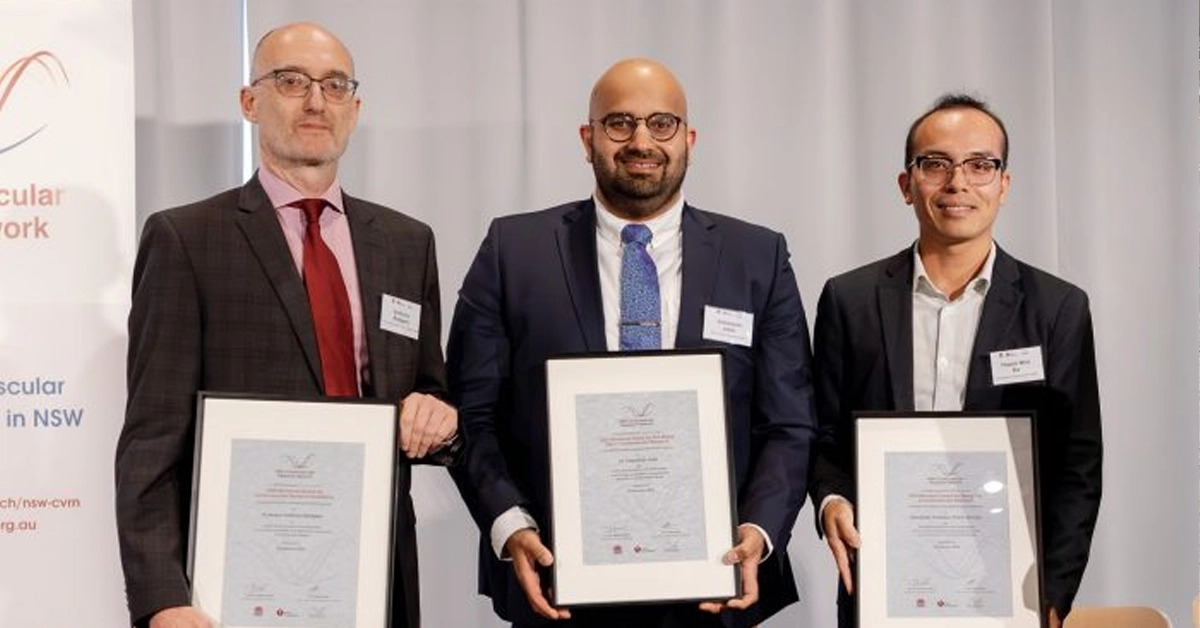
Researchers based at UNSW Sydney have secured three of the four awards presented at the 2025 Cardiovascular Research Network Ministerial Awards for Cardiovascular Research, announced on 25 February 2026.
The awards recognise significant contributions to research addressing cardiovascular disease, diabetes, stroke and renal disease. NSW Minister for Medical Research, the Hon. David Harris, presented the honours to the winners.
Career-Long Commitment to Heart Health
Conjoint Professor Anthony Rodgers from The George Institute for Global Health and UNSW Medicine & Health received the Ministerial Award for Cardiovascular Research Excellence, the program’s highest honour.
Professor Rodgers has devoted more than three decades to cardiovascular research, with particular focus on preventing disease and addressing global health disparities. His work on developing a low-dose triple combination pill for hypertension treatment has progressed from initial concept to an approved medication.
The treatment, which received US Food and Drug Administration approval in 2025 and was added to the World Health Organisation Essential Medicines List, has been shown to reduce the risk of secondary stroke by 40 per cent.
“Research is always a team sport, especially when tackling big, complex challenges, and this award belongs to every team member, past and present, who has contributed to our shared efforts,” Professor Rodgers said.
He noted that gaining regulatory approval and WHO recognition represented important milestones, but emphasised that ensuring access to the treatment in Australia and internationally remains the ongoing challenge.
Bio-Robotics Innovation in Cardiac Care
Scientia Associate Professor Thanh Nho Do from UNSW Engineering’s School of Biomedical Engineering was named winner of the 2025 Ministerial Award for Rising Star in Cardiovascular Research.
Associate Professor Do leads the UNSW Medical Robotics Lab, which he established, and specialises in soft robotics and cardiac devices. The lab’s work aims to provide less invasive and more precise treatment options for heart disease patients.
Recent innovations from the lab include a flexible robot capable of 3D-printing living materials inside the body for organ repair, and an ultra-thin catheter designed to reach deep into the brain to remove clots in stroke and aneurysm cases.
“This award is a great achievement for me and my team. It recognises our ambitious, high-impact research to develop next-generation soft robotic tools for safer, better treatment for doctors and patients,” Associate Professor Do said.
The Medical Robotics Lab has also developed an external bionic heart sleeve that assists failing hearts without direct blood contact, reducing infection risk compared with conventional devices. The team has created a soft robotic artificial heart that replicates natural heart motion and blood flow for device testing and treatment planning purposes.
Advancing Heart Transplant Success
Dr Yashutosh Joshi from Victor Chang Cardiac Research Institute won the Ministerial Award for PhD Rising Star in Cardiovascular Research.
Dr Joshi’s research examined ways to optimise donor heart preservation to expand the number and quality of hearts suitable for transplantation. His work identified critical time factors affecting recipient survival rates and found that blood thinners and a spider-venom derived peptide called Hi1a could substantially improve donor heart protection, potentially increasing transplantation success rates.
Dr Joshi is currently training as a cardiothoracic surgery trainee at Westmead Hospital.
The Cardiovascular Research Network presents these awards annually to acknowledge research contributions in the field of cardiovascular disease and related conditions.
Published 25-February-2026